Key Takeaways
Review responses will either strengthen trust before booking or quietly send guests to another hotel.
Potential guests don’t read replies as admin work. They read them as evidence of how your team listens, fixes problems, and speaks when something goes wrong. That’s why bad hotel review response examples stand out so quickly on hotel pages. A short reply can feel thoughtful, while a longer one can still feel careless if it sounds copied, vague, or late.
6 Hotel review response red flags guests notice first
Potential guests spot a weak reply pattern quickly. They don’t need to read every review. A handful of responses will show if your team is present, rushed, or on autopilot. These six signals appear often, and each one shapes trust before rate, room type, or location does.
Response signal | What guests take from it |
|---|---|
1. Repeated wording tells guests the hotel runs on autopilot | When several replies sound the same, readers assume the hotel is processing feedback rather than paying close attention to each stay. |
2. Generic replies ignore the details guests actually read | A reply that skips the actual issue makes the hotel look inattentive, even when the original complaint was small. |
3. Copied signatures make every response feel outsourced | Repeated sign-offs and awkward titles can make the whole page feel detached from the property’s actual people. |
4. Defensive language makes service problems look unresolved | Guests trust calm accountability more than excuses when a review mentions noise, cleanliness, or staff conduct. |
5. Slow replies signal weak guest care after checkout | Long gaps before a response suggest poor follow-through and tell readers that communication fades once the stay ends. |
6. Empty apologies leave future guests without reassurance | Readers want to see what was checked, corrected, or escalated, because a vague apology gives them nothing concrete to trust. |
1. Repeated wording tells guests the hotel runs on autopilot
Guests notice repeated wording faster than most hotel teams expect. A run of replies that all say, “Thank you for your valued feedback and we hope to welcome you again soon,” will read like a template within seconds. That reaction isn’t harsh. It’s a normal reading pattern when someone is comparing several properties at speed.
A prospective guest on Google or TripAdvisor will often open three or four recent reviews in one sitting. If each response follows the same rhythm, uses the same apology, and ends with the same promise, your page starts to look unattended. That matters because review response mistakes hotel teams make are judged as a pattern, not as isolated slips. Repetition turns a weak process into a visible signal of autopilot management.
"Guests notice repeated wording faster than most hotel teams expect."
2. Generic replies ignore the details guests actually read
A generic reply tells guests your team either didn’t read the review or didn’t care enough to answer it properly. When someone reports a broken air-conditioning unit and the reply thanks them for enjoying their stay, the mismatch is impossible to miss. Readers won’t give you the benefit of the doubt. They’ll assume guest communication isn’t a priority.
Specific complaints need specific acknowledgement. A note about a late check-in, a noisy corridor, or a cold breakfast should be answered with language that shows the issue was understood. Hotel Speaker fits that execution need because it pairs hotel context with human editorial review before a response is published. That process matters because template language fails hotels at the exact moment future guests want reassurance.
3. Copied signatures make every response feel outsourced
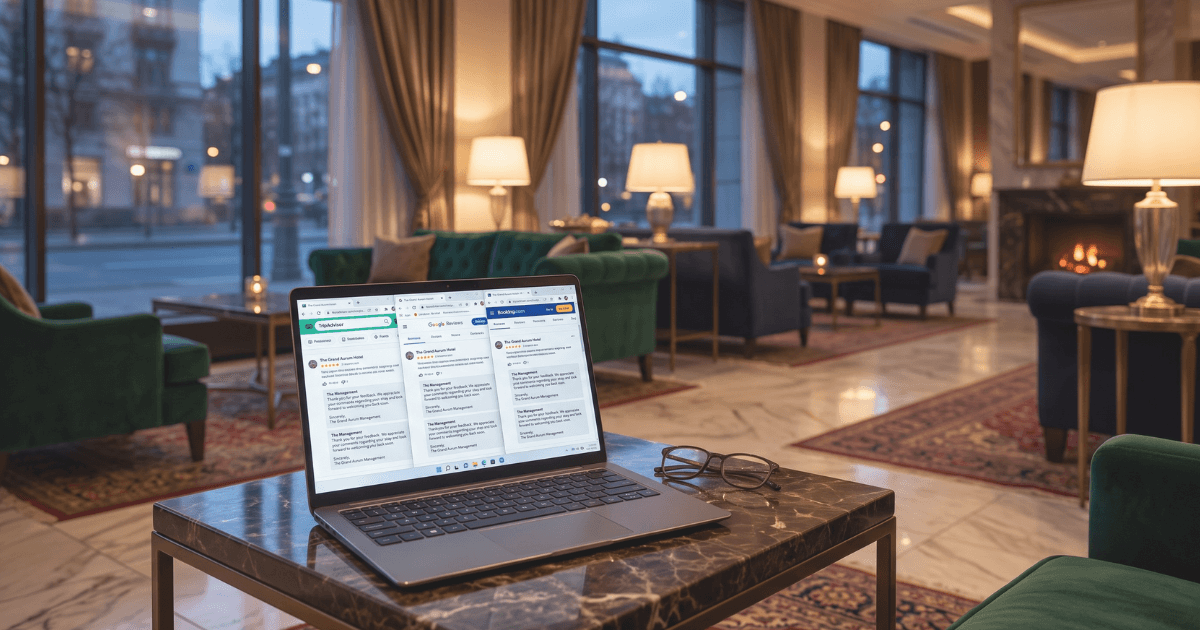
Signatures look small, yet they shape trust quickly. If every reply is signed by the same manager, even across weekends, holidays, and overnight reviews, guests start to question who is actually speaking. That doubt grows when the title shifts between platforms or sounds more like a script than a real role. Small credibility gaps add up fast on a public review page.
Some poor hotel review response examples look polished until the final line. A copied sign-off such as “Warm regards, Guest Relations Team” under dozens of unrelated replies feels detached, especially at a boutique property selling personal service. You don’t need a different flourish every time, but you do need consistency that still feels human. If the signature looks pasted, the rest of the response will feel pasted too.
4. Defensive language makes service problems look unresolved
Defensive replies do more than irritate the original reviewer. They warn future guests that the hotel argues before it listens. Once a response starts explaining why the guest was wrong, the service issue looks larger and more stubborn than the review itself. Readers will remember the tone more than the hotel’s explanation.
A common version appears after a complaint about housekeeping or staff attitude. The reply says, “No other guest reported this,” or “Our standards are normally very high,” which sounds like self-protection instead of care. Guests are looking for calm ownership, even when a review feels unfair. A measured response that acknowledges the concern and states what was checked will always land better than a public rebuttal.
5. Slow replies signal weak guest care after checkout
Late responses make a hotel look slow, disorganised, or indifferent. When a negative review sits unanswered for weeks, potential guests assume the property lacks process or loses interest once payment is taken. That impression sticks because response timing is easy to compare across listings. A slower hotel won’t look attentive, even if the eventual wording is polished.
Timing carries weight because review pages act like a public service record. A traveller comparing two similar hotels on Booking.com or Google will notice if one property responds within a day or two while the other leaves issues hanging for a month. Positive reviews suffer here as well, because delayed thanks feel routine rather than sincere. Many signs of lazy hotel review management come down to one visible pattern: replies matter to the hotel, yet they still aren’t timely.
6. Empty apologies leave future guests without reassurance
An apology without substance doesn’t calm future guests. A line such as “We are sorry your stay did not meet expectations” says very little if the review described mould in the bathroom, a billing error, or rude service at reception. Readers aren’t looking for perfect operations. They’re looking for signs that problems are taken seriously and corrected.
A stronger reply gives a small amount of useful detail. It might say the room was inspected, the maintenance issue was fixed, or the department manager reviewed the service lapse with the team involved. That specificity shows action without turning the response into a report. When replies stop at a vague apology, they read like legal cover rather than guest communication.
"Guests don’t reward speed alone. They reward signs of attention, and those signals will shape trust long after the original stay is over."
How to spot response problems before they hurt bookings
You can spot response problems quickly if you read recent replies through a shopper’s eyes. Ten replies are usually enough. If the voice slips, the timing drifts, or the details go missing, trust starts to drop. That judgment happens long before a guest reaches your booking engine.
A useful review audit is simple and repeatable. Check if each reply mentions the actual experience, uses a natural sign-off, answers complaints without blame, and appears while the stay is still fresh. Read the page in one sitting, because patterns stand out more clearly when you see them close together. That habit will expose hotel review response red flags faster than any internal status report.
Disciplined execution is what fixes this over time. Hotel Speaker fits that operating model because it pairs contextual AI with human editorial review, which keeps responses specific, timely, and consistent without sounding machine-made. Guests don’t reward speed alone. They reward signs of attention, and those signals will shape trust long after the original stay is over.
